

AHA vs. BHA: What’s the Difference & Which One Does Your Skin Need?
If you’ve spent any time looking at exfoliating skincare products, you’ve probably seen AHA and BHA written on bottles, serums, toners and peels.
They’re both chemical exfoliants—but they don’t behave exactly the same way in the skin.
So how do you know which one your skin needs?
Let’s break it down simply.
First: Why Do We Exfoliate?
Our skin naturally sheds dead cells, but sometimes those cells can accumulate on the surface.
This can contribute to skin looking:
Dull
Rough or uneven
Congested
Flaky
Less radiant
Exfoliating helps loosen and remove some of this buildup.
Unlike a physical scrub, which mechanically rubs away surface cells, AHAs and BHAs chemically loosen the bonds associated with dead skin-cell buildup.
But this is where AHA and BHA begin to differ.
What Is an AHA?
AHA stands for Alpha Hydroxy Acid.
AHAs are water-soluble exfoliating acids that primarily work at the skin's surface.
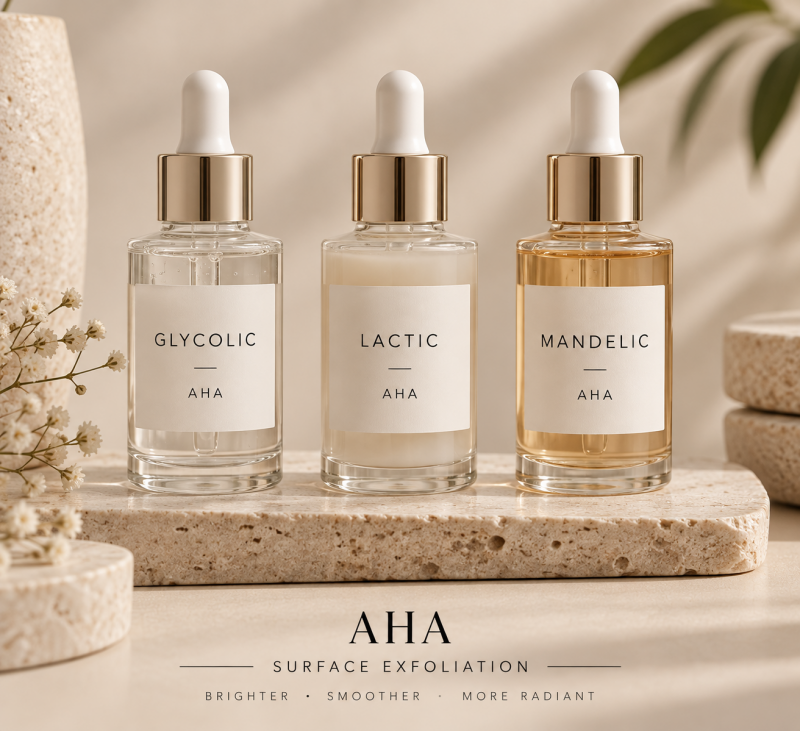
Some of the most common AHAs you'll see in skincare include:
Glycolic Acid
Lactic Acid
Mandelic Acid
Although they're all AHAs, they aren't interchangeable. Their molecular size, concentration, pH and formulation can influence how strongly a product interacts with the skin.
Who might benefit from an AHA?
AHAs are commonly used when the main concerns are:
Dullness
Rough texture
Uneven-looking skin tone
Surface pigmentation
Fine lines and signs of photoaging
If someone tells me, “My skin just looks dull and doesn't feel smooth anymore,” an AHA may be one ingredient worth considering.
But Not Every AHA Is the Same
This is something that gets overlooked.
Glycolic Acid
Glycolic acid has a relatively small molecular size and can be an effective exfoliant.
Because of that, it can also be irritating for some sensitive or compromised skin when used too aggressively.
Lactic Acid
Lactic acid provides exfoliation while also having humectant properties.
It can sometimes be a more comfortable option for someone looking for exfoliation while also dealing with dryness.
Mandelic Acid
Mandelic acid has a larger molecular structure than glycolic acid and penetrates more slowly.
For that reason, it is often considered when a gentler exfoliating approach is desired, including for some sensitive or acne-prone skin types.
The strongest acid isn't automatically the best acid.
The goal is to choose something appropriate for the skin.
What Is a BHA?
BHA stands for Beta Hydroxy Acid.
The BHA you'll most commonly see in skincare is:
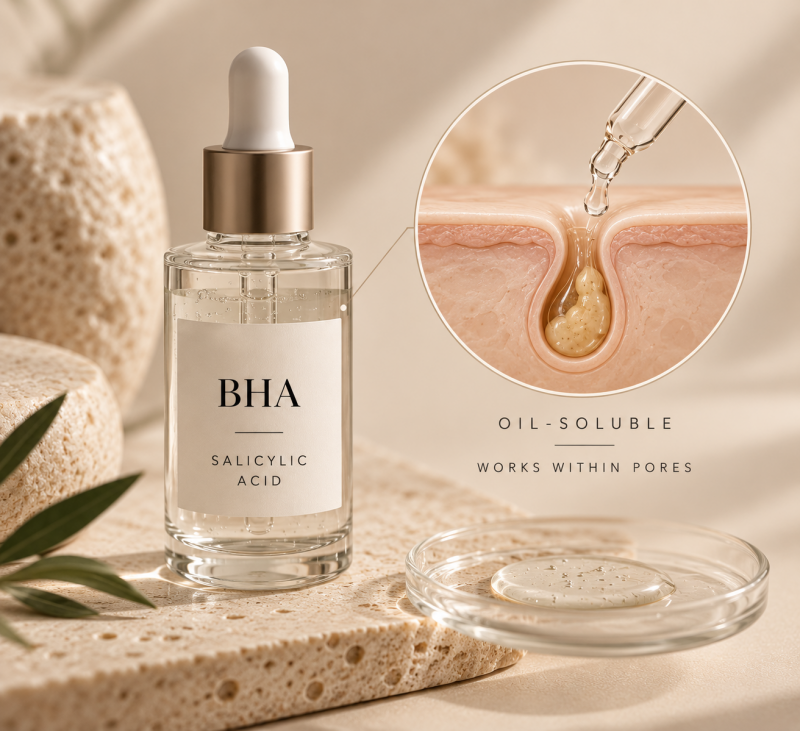
Salicylic Acid
Here's the major difference.
While AHAs are water-soluble, salicylic acid is oil-soluble.
That means it can move into oily areas of the follicle and help loosen the mixture of excess sebum and dead cells associated with clogged pores.
This is why BHA is frequently used for:
Oily skin
Congestion
Blackheads
Clogged pores
Acne-prone skin
Think about it this way:
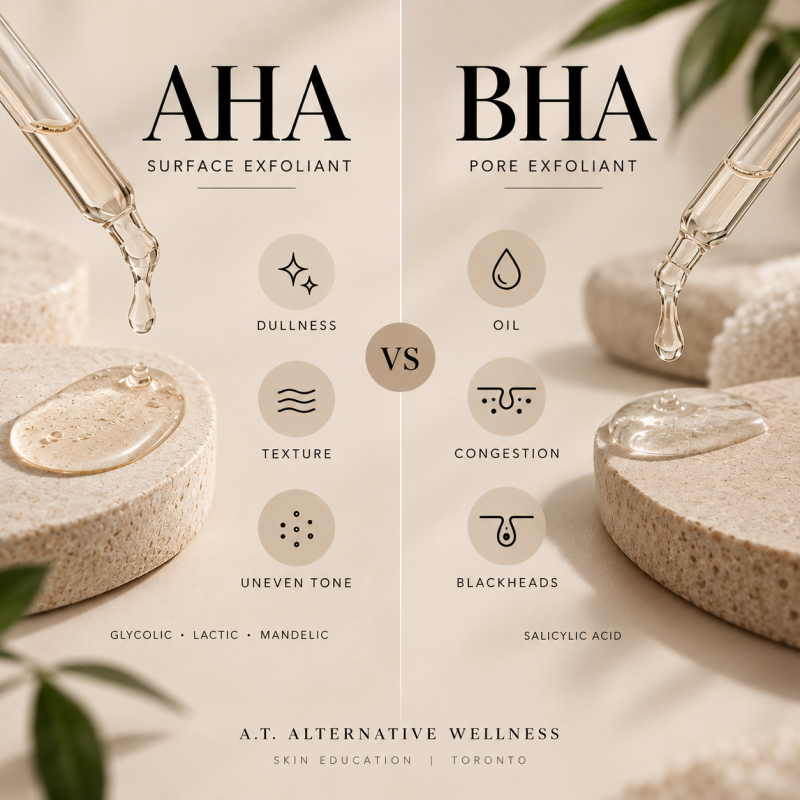
AHA → Think SURFACE
Dullness • Texture • Uneven tone
BHA → Think PORES
Oil • Congestion • Blackheads
That's an oversimplification of the chemistry, but it's an easy way to remember the practical difference.
What If You Have Acne AND Pigmentation?
This is where skincare becomes more individualized.
Someone can easily have:
oily skin + congestion + post-acne marks + uneven texture.
So does that person need AHA or BHA?
Potentially either—or sometimes both as part of a carefully designed routine.
For example, BHA may be useful for addressing congestion while an AHA may be selected to address surface texture and uneven-looking tone.
That does not mean you should immediately start layering several exfoliating acids together.
How they're introduced and scheduled matters.
Can You Use AHA and BHA Together?
Sometimes—but more exfoliation does not automatically produce better skin.
This is one of the biggest mistakes I see with skincare.
Someone starts using an acid.
Then they add another exfoliating toner.
Then retinol.
Then an exfoliating cleanser.
And suddenly they're wondering:
“Why is my skin burning?”
The problem may not be that any individual ingredient is bad.
The overall routine may simply be too aggressive for that person's skin.
Signs that you may be over-exfoliating include:
Burning or stinging
Persistent redness
Tightness
Increased sensitivity
Flaking
Skin suddenly reacting to products it previously tolerated
When this happens, adding another active ingredient usually isn't the solution.
Sometimes the skin needs less.

So… AHA or BHA?
Here's the simplest way to start thinking about it:
Choose based on the concern—not the trend.
If you're primarily concerned about:
Dullness • Rough texture • Uneven tone
→ An AHA may make sense.
If you're primarily concerned about:
Oiliness • Congestion • Blackheads
→ A BHA may make sense.
If you're dealing with several concerns at once, that's where a more individualized approach becomes important.
The A.T. Alternative Wellness Perspective
At A.T. Alternative Wellness, I don’t believe in choosing skincare simply because an ingredient is trending or because a higher percentage sounds more powerful.
When it comes to AHA vs. BHA, the better choice depends on the skin in front of me.
Is the main concern dullness and uneven texture? Is there excess oil and congestion? Is the skin sensitive or already over-exfoliated? What other active ingredients are being used? These details matter.
Sometimes an AHA makes sense. Sometimes a BHA is more appropriate. Sometimes the best decision is to step away from exfoliation altogether and focus on supporting the skin barrier first.
More products and stronger acids don't automatically create healthier skin.
My approach is simple:
Understand the skin. Choose ingredients with a purpose. Treat gradually. Protect the skin barrier. Stay consistent.
Because good skincare isn't about doing the most.
It's about doing what makes sense for your skin.
A.T. Alternative Wellness | Toronto