

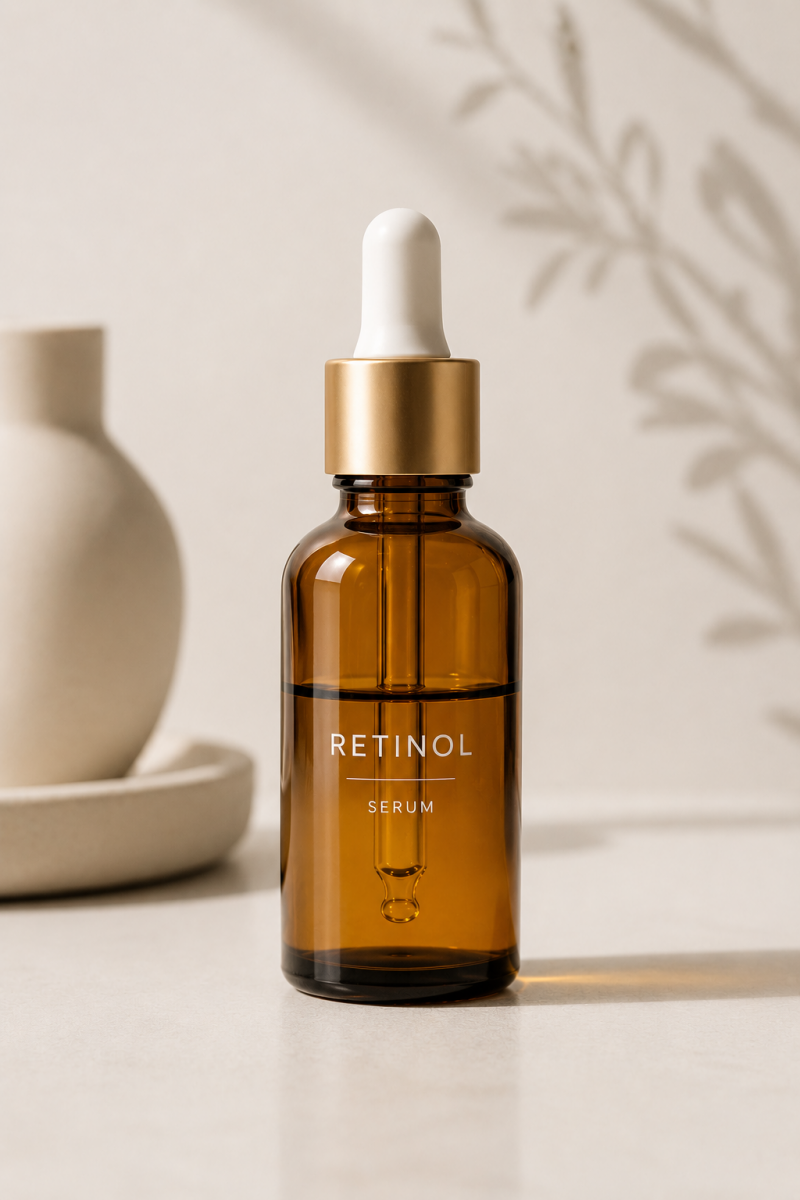
Retinol: What Does It Actually Do for Your Skin?
Retinol is one of the most talked-about ingredients in skincare—and also one of the most misunderstood.
You may have heard that retinol helps with wrinkles, acne, pigmentation, texture and pores. You may also have heard stories about peeling, redness, dryness or skin becoming irritated after starting it.
So what exactly is retinol? Where does it come from? Who should use it? And, just as importantly, what should you not combine with it?
Welcome back to the Ingredient Lab at A.T. Alternative Wellness, where we look beyond skincare trends and break down what ingredients actually do.
What Is Retinol?
Retinol belongs to a family of compounds called retinoids, which are derivatives of Vitamin A.
Vitamin A is a fat-soluble vitamin naturally present in certain foods and is essential for many processes in the body, including normal skin function.
In skincare, different forms of Vitamin A are used because they can influence how skin cells behave.
However, retinol is not the same thing as every other retinoid.
You may see names such as:
Retinyl palmitate
Retinol
Retinal or retinaldehyde
Tretinoin
Adapalene
Tazarotene
They all belong to the Vitamin A/retinoid family, but they are not interchangeable.
Where Does Retinol Come From?
Retinol is a form of Vitamin A.
Vitamin A occurs naturally in foods in different forms. Preformed Vitamin A is found primarily in animal-derived foods, while plants provide carotenoids such as beta-carotene that the body can convert into Vitamin A.
The retinol found in modern skincare formulations is generally manufactured as a cosmetic ingredient rather than extracted directly from foods.
This allows cosmetic chemists to formulate Vitamin A into creams, serums and other topical products at controlled concentrations.
How Does Retinol Work?
This is where retinol becomes particularly interesting.
Retinol itself isn't the final form that skin cells use.
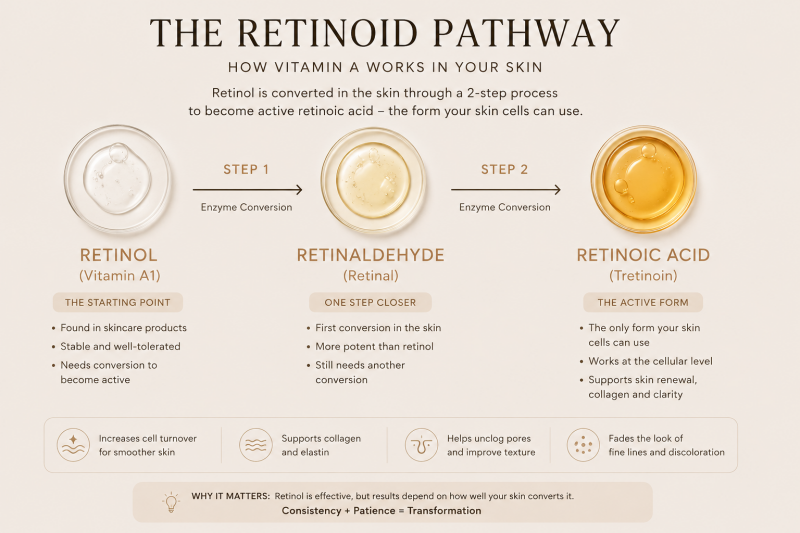
After retinol enters the skin, it must undergo conversion:
Retinol → Retinaldehyde → Retinoic Acid
Retinoic acid is the biologically active form that interacts with retinoid receptors in skin cells.
This conversion process is one reason different Vitamin A products can behave very differently on the skin.
A product containing retinol therefore cannot be compared simply by looking at the word “Vitamin A” on the label.
What Does Retinol Do for the Skin?
Retinoids are among the most extensively studied categories of topical skincare ingredients.
With appropriate and consistent use, retinol can help support several skin concerns.
1. Fine Lines & Visible Signs of Aging
Retinoids can influence processes involved in collagen production and skin renewal.
Over time, this may help improve the appearance of:
Fine lines
Uneven texture
Loss of firmness
Photoaged skin
This is why Vitamin A derivatives have become such important ingredients in age-management skincare.
2. Skin Texture
Retinol helps normalize epidermal cell turnover.
This can gradually create a smoother, more refined appearance to the skin.
It may be particularly helpful for skin that looks:
Rough
Dull
Uneven
Congested
3. Pigmentation & Uneven Skin Tone
Because retinoids influence cellular turnover and pigmentation pathways, they may help improve the appearance of certain types of uneven pigmentation over time.
Retinol is therefore frequently incorporated into routines targeting:
Sun-related discoloration
Post-acne marks
Uneven skin tone
Visible photoaging
However, pigmentation is complex. Retinol isn't automatically the correct treatment for every dark spot.
4. Acne & Congestion
Retinoids can be particularly useful for acne-prone skin because they help normalize the way cells shed within the follicle.
This can help reduce the formation of clogged pores.
Certain retinoids are used specifically for acne treatment, although the evidence and regulatory status differ between cosmetic retinol and medications such as adapalene or tretinoin.
5. The Appearance of Pores
Retinol does not physically "close" pores.
Pores do not open and close like doors.
However, by helping improve cellular turnover and congestion, retinoids may make enlarged or clogged pores appear less noticeable.
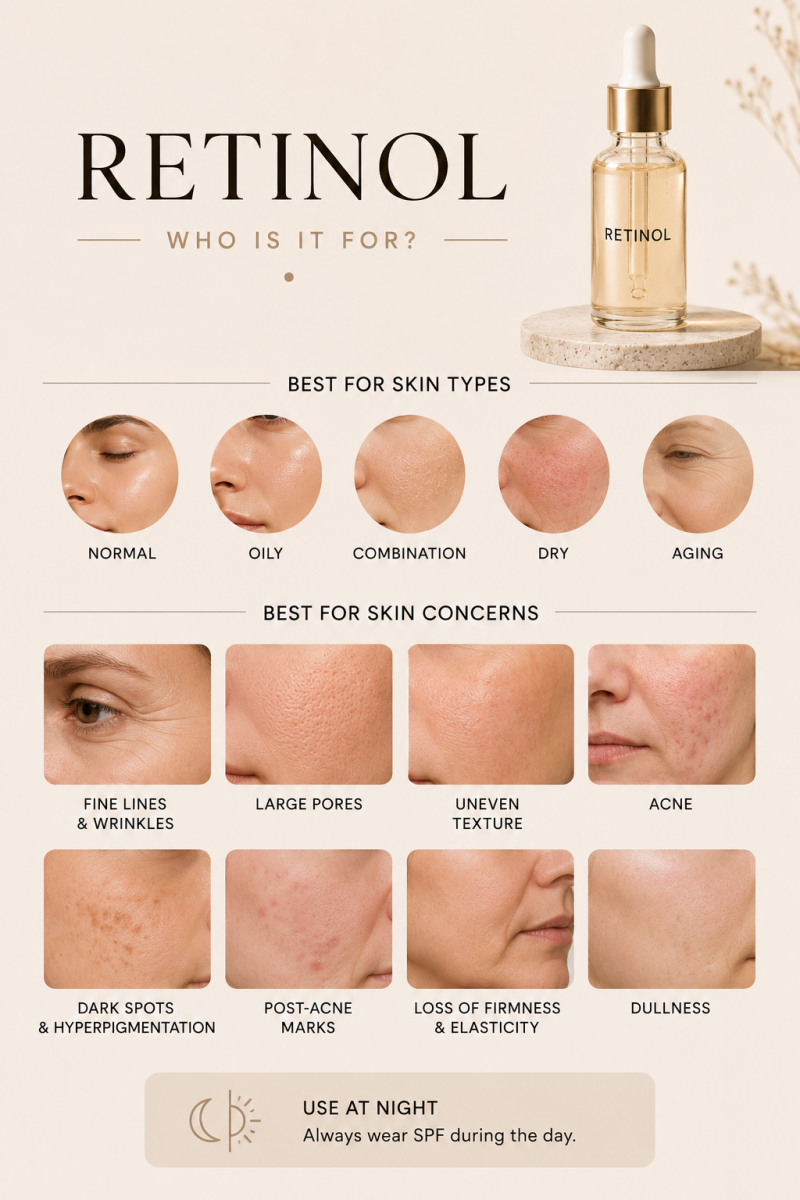
Who Is Retinol For?
Retinol may be beneficial for adults concerned with:
✓ Fine lines and visible aging
✓ Uneven skin texture
✓ Sun-damaged appearance
✓ Dullness
✓ Certain types of pigmentation
✓ Congested skin
✓ Acne-prone skin
✓ Preventative age-management skincare
But that does not mean everyone should immediately start using a strong retinol.
Your skin barrier, sensitivity, current products and treatment history all matter.
Who Should Be More Careful With Retinol?
Extra caution may be appropriate if your skin is currently:
Very sensitive
Extremely dry
Irritated or inflamed
Experiencing a compromised skin barrier
Sunburned
Recovering from certain professional treatments
Experiencing active dermatitis or another inflammatory skin condition
Retinoids are also generally avoided during pregnancy. Anyone who is pregnant, trying to become pregnant or breastfeeding should discuss topical retinoid use with their healthcare provider.
Retinol vs Retinal vs Tretinoin
This is one of the most important distinctions to understand.
RETINOL
Retinol is widely available in cosmetic skincare.
It requires two conversion steps before becoming retinoic acid:
Retinol → Retinal → Retinoic Acid
RETINAL / RETINALDEHYDE
Retinal is one conversion step closer:
Retinal → Retinoic Acid
It has become increasingly popular in professional and advanced skincare formulations.
TRETINOIN
Tretinoin is retinoic acid.
It does not require the same conversion process.
Tretinoin is a medication and is considerably different from purchasing an over-the-counter cosmetic retinol serum.
This is why comparing products simply by percentages can be misleading.
0.5% retinol is not equivalent to 0.5% tretinoin.
They are different molecules with different activity and tolerability.
Does a Higher Retinol Percentage Mean Better Results?
Not necessarily.
This is something I emphasize frequently at A.T. Alternative Wellness:
Higher ≠ automatically better.
A high percentage that repeatedly irritates your skin isn't necessarily going to give you better skin.
The effectiveness of a retinol product depends on much more than the number printed on the bottle.
The complete formulation matters.
That includes:
Type of retinoid
Concentration
Delivery system
Encapsulation
Stability
Packaging
Supporting ingredients
Frequency of use
Your individual skin tolerance
A sophisticated lower-strength formulation may sometimes be much more appropriate than simply choosing the highest percentage you can find.
Why Does Retinol Sometimes Cause Peeling?
When someone begins using a retinoid, they may experience what is commonly called retinization.
Symptoms can include:
Dryness
Tightness
Flaking
Mild redness
Increased sensitivity
Some adjustment can occur when beginning retinoid therapy.
But severe burning, cracking, persistent redness or significant inflammation should not be treated as proof that the product is "working."
More irritation does not equal better results.
Sometimes the skin is simply telling you that the product, strength, frequency or combination of products is too aggressive.
How Should You Start Retinol?
One of the biggest mistakes people make is starting too aggressively.
For many people, a better approach is to introduce retinol gradually.
For example:
Week 1–2: 1–2 evenings per week
Then, if the skin is tolerating it well:
Week 3–4: approximately every other evening
Frequency can then be adjusted according to the product and individual skin tolerance.
You do not necessarily need to use retinol every night to benefit from it.
How Much Retinol Should You Apply?
More product does not mean better results.
For most facial retinoid products, approximately a pea-sized amount for the entire face is generally sufficient.
Avoid aggressively applying it around sensitive areas such as:
Corners of the nose
Corners of the mouth
Eyelids
Very close to the eyes
unless the particular product has specifically been formulated and directed for those areas.
What CAN You Use With Retinol?
This is where supporting the skin barrier becomes very important.
Hyaluronic Acid
Hyaluronic acid can work very well in a retinol routine because it supports hydration without adding another strong exfoliating active.
Retinol + Hyaluronic Acid = generally a very compatible combination.
Ceramides
Ceramides help support the skin's barrier.
They can be particularly valuable when introducing retinol because dryness and barrier disruption are common reasons people discontinue Vitamin A products.
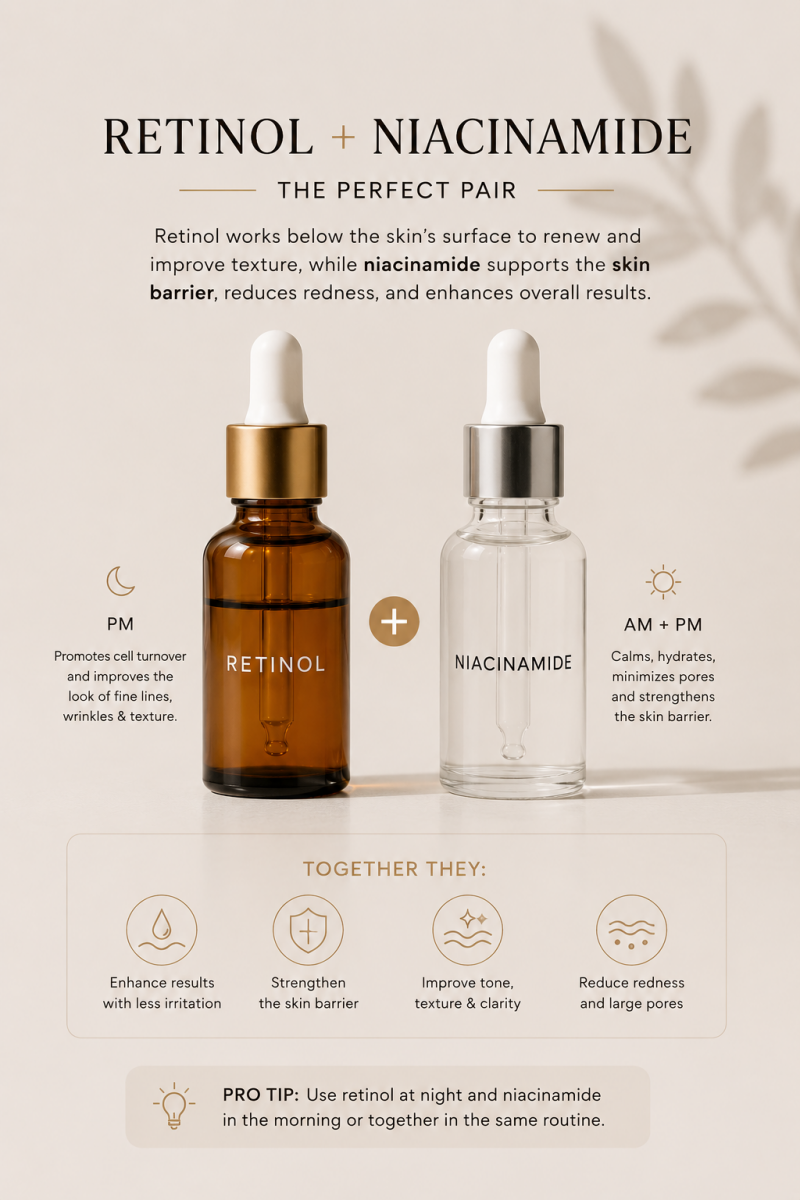
Niacinamide
Niacinamide can complement a retinoid routine very nicely.
Depending on the formulation, it can help support:
Skin barrier function
Hydration
More even-looking skin
Overall skin tolerance
Retinol + Niacinamide can therefore be an excellent combination for many people.
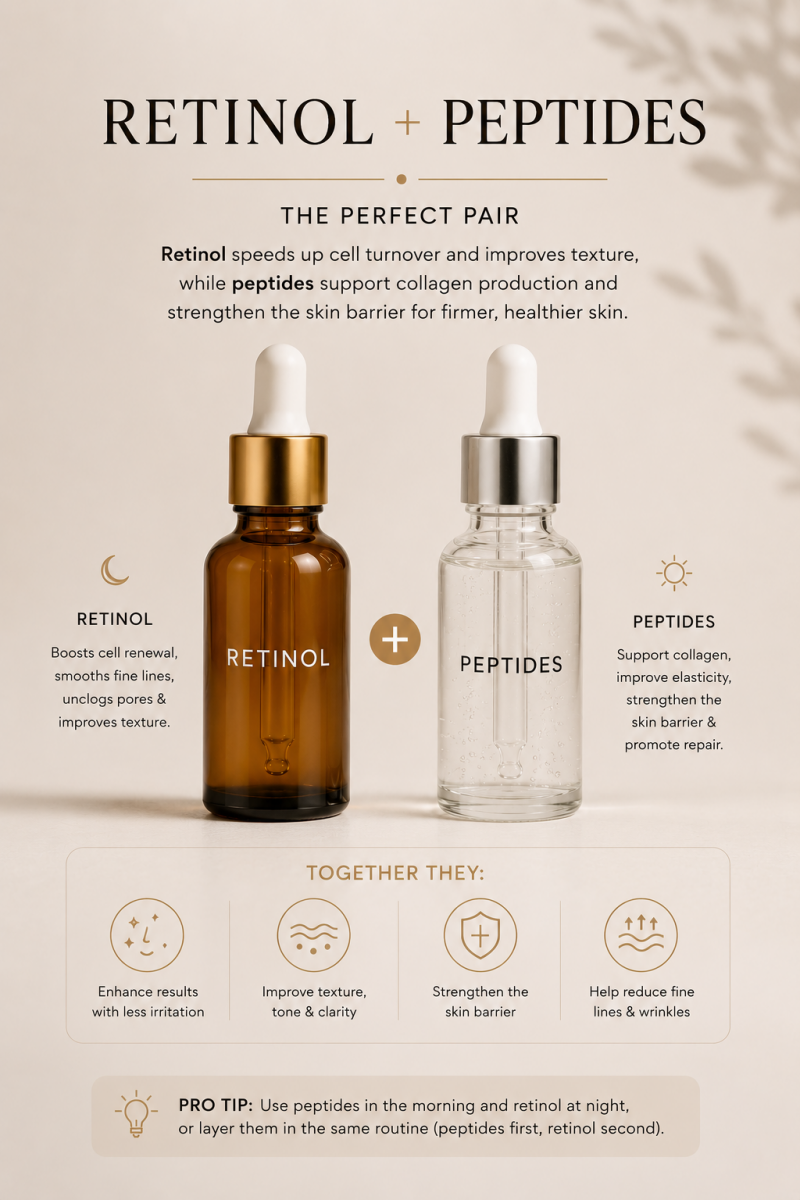
Peptides
Many peptide formulations can also be incorporated into a retinol routine.
Rather than adding another exfoliating stressor, peptides are commonly used as part of age-supportive skincare routines.
Moisturizer
Sometimes the most important product to combine with retinol is simply a good moisturizer.
If someone is sensitive, I may prefer a "sandwich" approach:
Moisturizer → Retinol → Moisturizer
This can reduce the intensity of exposure and make retinol easier for some skin types to tolerate.
What Should You Be Careful Using With Retinol?
This is where people often run into problems.
The question isn't always:
"Can these ingredients ever be used together?"
The better question is:
"Should YOUR skin be using them together, at these strengths, at this frequency?"
Retinol + AHAs
AHAs include ingredients such as:
Glycolic acid
Lactic acid
Mandelic acid
Both AHAs and retinol can increase irritation when used aggressively.
Some experienced users may tolerate both within the same overall routine, but introducing them simultaneously or layering strong formulations can cause unnecessary barrier irritation.
A simple approach may be:
Night 1 — Retinol
Night 2 — Recovery/hydration
Night 3 — Exfoliating acid
rather than layering everything at once.
Retinol + BHA / Salicylic Acid
Salicylic acid can be useful for oily, acne-prone and congested skin.
However, combining a strong BHA treatment with retinol may significantly increase dryness and irritation in some people.
Again, alternating nights may be more appropriate.

Retinol + Benzoyl Peroxide
This combination requires more nuance.
Benzoyl peroxide and retinoids are both commonly used for acne, but compatibility depends on the specific retinoid and formulation.
Some traditional combinations can create irritation and stability concerns, while certain modern formulations and acne regimens intentionally combine retinoids with benzoyl peroxide.
If you're treating acne, this is an area where professional guidance is particularly useful rather than experimenting with multiple strong products.
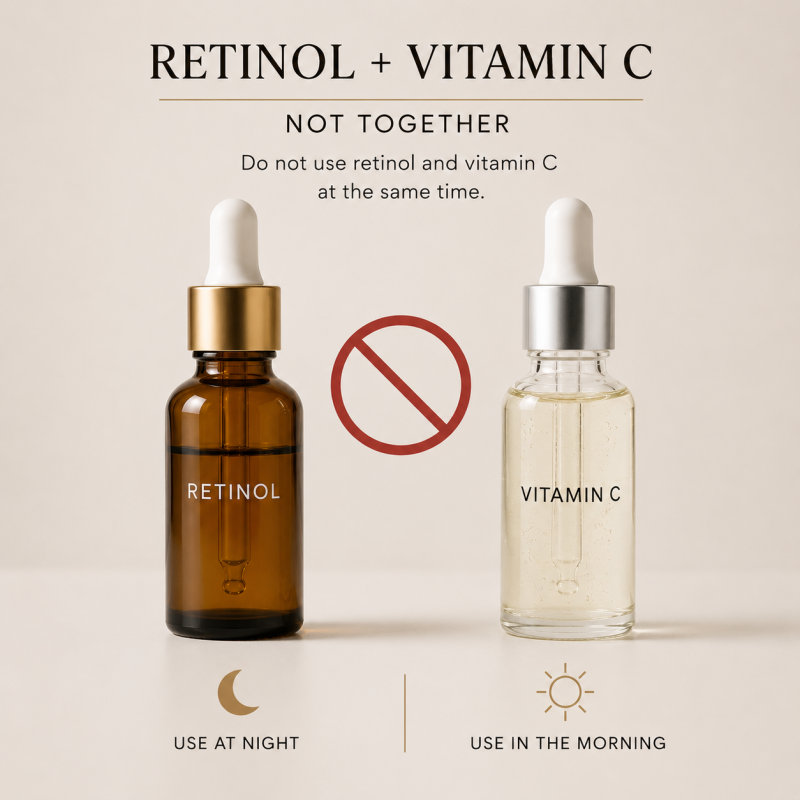
Retinol + Vitamin C
You may have heard:
"Never use Vitamin C and retinol together."
That's too simplistic.
Whether they can be combined depends on the Vitamin C derivative, retinoid formulation, concentrations and the person's skin.
However, for a simple routine—particularly for sensitive or inexperienced skin—I often prefer:
MORNING
Vitamin C
↓
Moisturizer
↓
SPF
EVENING
Cleanse
↓
Retinol
↓
Moisturizer
This gives both ingredients a place in the routine without unnecessarily overwhelming the skin.
And What About Sunscreen?
This is non-negotiable.
If you're investing in ingredients intended to improve visible photoaging and pigmentation while repeatedly exposing your skin to unprotected UV radiation, you're working against your own skincare goals.
Use a broad-spectrum SPF 30 or higher every morning and reapply appropriately with ongoing sun exposure.
Your retinol routine and sun-protection routine should go hand in hand.
Retinol & Professional Treatments
If you're receiving professional treatments such as:
Chemical peels
Microneedling
Dermaplaning
Certain laser or light treatments
Strong resurfacing treatments
your retinol may need to be temporarily discontinued before and/or after treatment.
The timing depends on the particular retinoid, its strength, your skin and the procedure being performed.
This is one reason it's important to tell your aesthetician everything you're currently using at home.
Why Professional Consultation Matters
Two people can purchase exactly the same retinol product and have completely different experiences.
One person's skin may tolerate it beautifully.
Another may develop persistent dryness, irritation and barrier disruption.
At A.T. Alternative Wellness, I don't believe good skincare should simply be about chasing the strongest percentage or the newest trending ingredient.
After more than 20 years working with skin, I've learned that the most effective routine is often the one your skin can actually tolerate consistently.
Your age, skin condition, sensitivity, pigmentation, lifestyle, current products and professional treatments all need to be considered.
Sometimes the answer is a stronger active.
Sometimes the answer is less.
That's why skincare should be personalized rather than copied from somebody else's routine.
Ingredient Lab Takeaway
If you remember only five things about retinol, remember these:
1. Retinol is a Vitamin A derivative.
2. Retinol must be converted by the skin before reaching active retinoic acid.
3. Higher percentages don't automatically mean better results.
4. Retinol can help with visible aging, texture, pigmentation, congestion and acne—but it must be used appropriately.
5. A healthy skin barrier and daily sun protection are just as important as the active ingredient itself.
Not sure whether retinol belongs in your routine?
If you're confused about which Vitamin A product to choose, what strength to use, or how to combine retinol with the products you already own, a professional skin consultation can help take the guesswork out of your routine.
Book a personalized skin consultation with A.T. Alternative Wellness in Toronto.
Because good skincare isn't about using the most products.
It's about understanding what your skin actually needs.