


PDRN Explained: Salmon DNA, Skin Repair & Rejuvenation
The Ingredient Lab | A.T. Alternative Wellness
PDRN has become a popular ingredient in regenerative aesthetics and Korean skincare. It is promoted for skin repair, collagen support, improved texture and rejuvenation.
But what exactly is PDRN, how does it work, and how much of the science applies to skincare products?
What is PDRN?
PDRN stands for Polydeoxyribonucleotide.
It is a mixture of purified DNA fragments composed of chains of nucleotides—the building blocks of DNA.
Unlike hyaluronic acid, which primarily helps retain water or retinol, which influences skin-cell behavior through retinoid receptors, PDRN is investigated for its potential role in supporting tissue repair and recovery.
PDRN is not a living cell, stem cell or exosome. It is also not an ingredient that replaces or rewrites your DNA.
Traditionally, pharmaceutical-grade PDRN is extracted from the sperm cells (milt) of salmonid fish, particularly salmon and trout.
The manufacturing process generally involves:
Collecting the DNA-containing biological material.
Extracting and purifying the DNA.
Processing it into fragments of controlled sizes.
Removing unwanted proteins and other biological contaminants.
Testing the finished material for purity and quality.
The result is purified DNA fragments, not raw salmon sperm.
You may also see products marketed as plant-derived PDRN or vegan PDRN. These may contain plant-derived DNA fragments or other polynucleotide preparations, but they should not automatically be assumed to have the same composition, clinical evidence or biological effects as the salmon-derived PDRN used in medical research.
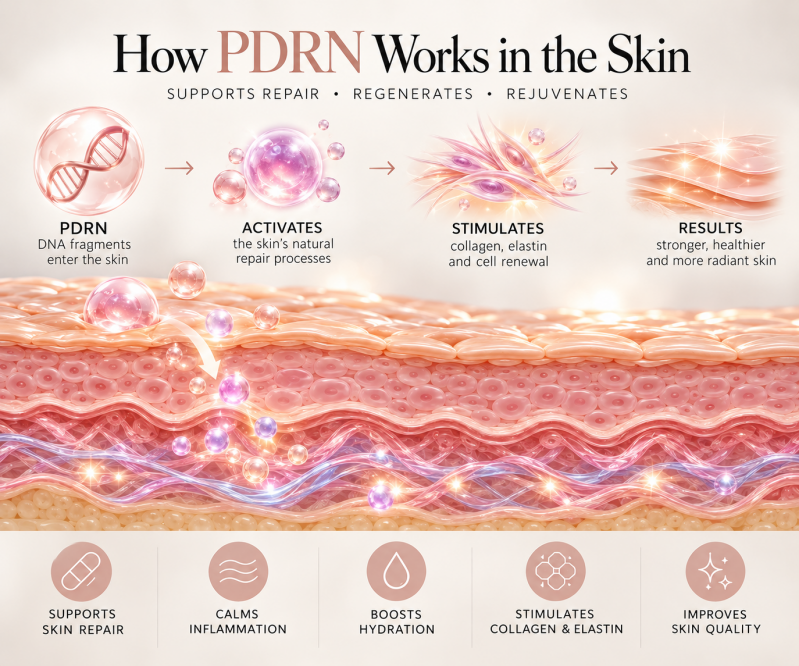
Some experimental studies suggest that PDRN may support fibroblast function and collagen-related processes. Fibroblasts are cells responsible for producing collagen and other components of the extracellular matrix.
However, this does not establish that applying a PDRN cosmetic serum will meaningfully rebuild collagen in human skin.
The important distinction is between a biological mechanism observed in research and a visible clinical improvement demonstrated in people.
What does research show about wrinkles, skin repair and rejuvenation?
This is where PDRN becomes particularly interesting.
Skin repair and wound healing
Fine lines and wrinkles
Collagen and skin firmness
Skin texture and rejuvenation
Oily or acne-prone
Can be suitable; choose non-comedogenic formulations and assess other ingredients
Sensitive skin
Patch test first; avoid introducing several new actives simultaneously
Rosacea
Use caution during flares; prioritize barrier care and low-irritation formulations
Hyperpigmentation or melasma
Early research is interesting, but PDRN is not an established first-line pigment treatment
Compromised or broken skin
Avoid applying ordinary cosmetic products to open skin unless specifically approved for that use
People with known fish allergies should seek medical advice before using fish-derived PDRN, particularly injectable preparations.
PDRN: Don't Buy the Trend. Understand the Formula.
Not all PDRN skincare products are created equal.
Two serums may both advertise PDRN, yet contain different concentrations, DNA fragment sizes, supporting ingredients and delivery systems.
Before purchasing, research the source, actual concentration, formulation and clinical evidence behind the product.
A high percentage doesn't automatically mean better results. A product containing PDRN doesn't necessarily penetrate deeply enough to deliver the same benefits observed in professional or medical studies.
Remember: The ingredient name tells you what's included. The formulation and scientific evidence tell you what the product may realistically achieve.
Choose skincare based on evidence, not marketing.
A.T. Alternative Wellness Perspective
At A.T. Alternative Wellness, I believe that understanding an ingredient is just as important as knowing its benefits.
PDRN is an exciting ingredient with promising research in skin repair and rejuvenation. However, not every product containing PDRN will deliver the same results.
The presence of an ingredient doesn't guarantee its effectiveness. Its concentration, molecular size, formulation, delivery system and supporting scientific evidence all play an important role.
I encourage my clients to look beyond trending ingredients and marketing claims. A higher percentage doesn't necessarily mean a better product, and an expensive serum doesn't automatically mean better results.
It's also important to understand the difference between what an ingredient can achieve in a laboratory, through professional treatments and when applied topically in a skincare product.
My approach is simple: skincare should be chosen based on your skin's needs, the science behind the formulation and realistic expectations - not trends.
My goal is to help you make informed decisions, understand what you're applying to your skin and invest in products and treatments that make sense for your individual concerns.
Healthy skin starts with knowledge, not hype.
A.T. Alternative Wellness
Not sure which skincare ingredients are right for your skin?
I'll help guide you toward ingredients suited to your skin's needs.