

Why Skin Ages — And What Really Influences the Aging Process
Your Skin Is Changing Every Day
Have you ever looked in the mirror and wondered, “When did that line appear?”
Skin aging can sometimes feel as though it happens overnight, but behind the scenes, your skin has actually been changing gradually for years.
Your skin is a living, constantly evolving organ. It creates new cells, repairs damage, maintains hydration, produces collagen and protects you from the outside world—all day, every day.
As we get older, some of these processes naturally become slower and less efficient.
But here's what makes aging particularly interesting:
Your age is only one part of the story.
Genetics, hormones, sun exposure, lifestyle, environment and skincare habits can all influence how your skin ages.

So, What Actually Happens to Our Skin?
Think of young skin as having a very efficient repair team.
Damage occurs, and the body gets to work repairing it. New cells are produced, collagen provides structural support, elastin provides flexibility, and natural substances such as hyaluronic acid help maintain hydration.
As we age, that repair team doesn't disappear—it simply doesn't work quite as quickly as it once did.
Gradually:
Collagen production decreases.
Elastin loses some of its strength and flexibility.
Hyaluronic acid levels decline.
Skin cell renewal slows.
Oil production may decrease.
The skin barrier may become less efficient.
Healing can take longer.
Fat and supporting facial tissues change.
Even the bones of the face gradually change with age.
The result?
You may begin noticing fine lines, dryness, dullness, pigmentation, changes in texture, reduced firmness or changes in facial contours.
And everyone's timeline is different.
Why Does One Person Seem to Age Faster Than Another?
This is where skin aging gets really interesting.
Two people of exactly the same age can have very different-looking skin.
Why?
Because there are two major sides to skin aging.
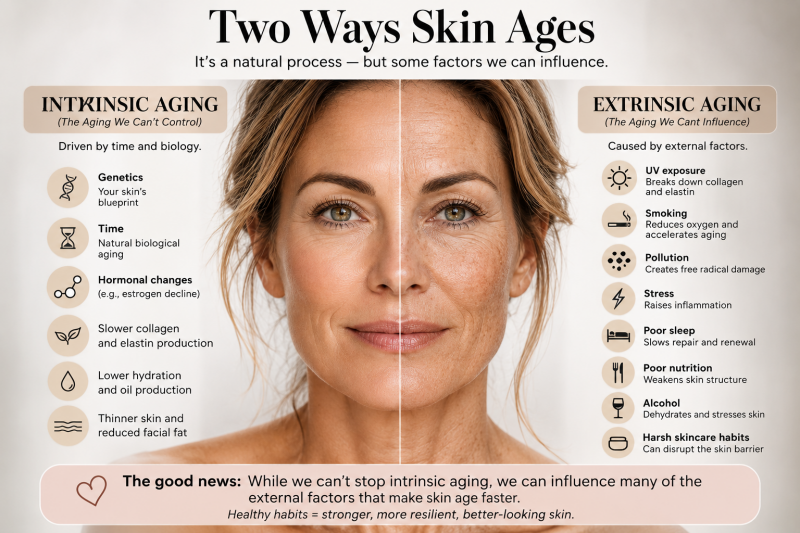
Intrinsic Aging vs Extrinsic Aging
Intrinsic Aging: The Aging We Can't Control
Intrinsic aging is your natural biological clock.
Genetics, hormonal changes and the passage of time influence how quickly collagen production slows, how your skin retains moisture and how its structure changes.
We can't stop this process—and we don't need to.
It's a normal part of being human.
Extrinsic Aging: The Aging We Can Influence
The second type comes from outside influences.
These include:
UV exposure
Smoking
Pollution
Chronic stress
Poor nutrition
Inadequate sleep
Excessive alcohol
Environmental exposure
Inappropriate or overly aggressive skincare
And unlike chronological aging, many of these factors can be modified.
☀️ The Biggest External Skin Ager? The Sun. Coming soon!