


UVA vs. UVB: What’s Actually Happening to Your Skin?
You Can Damage Your Skin Without Ever Getting a Sunburn
When most people think about sun damage, they picture a red, painful sunburn after spending too much time outside.
But here’s something many people don’t realize:
Your skin can be accumulating UV damage even when it never turns red, feels hot, or burns.
That’s because sunlight contains different types of ultraviolet radiation, and the two that affect our skin the most—UVA and UVB—behave very differently once they reach the skin.
Both can contribute to skin damage and skin cancer, but they penetrate the skin differently and create different types of cellular damage.
Understanding that difference can completely change the way you think about sun protection.
First: What Does UV Actually Mean?
UV stands for ultraviolet radiation.
Ultraviolet light is part of the energy produced by the sun. We cannot see it with our eyes, but our skin can certainly be affected by it.
The easiest way to remember them is:
UVA = Aging
UVB = Burning
That is a simplified way of thinking about them—because both types can damage skin—but it is a helpful place to start.
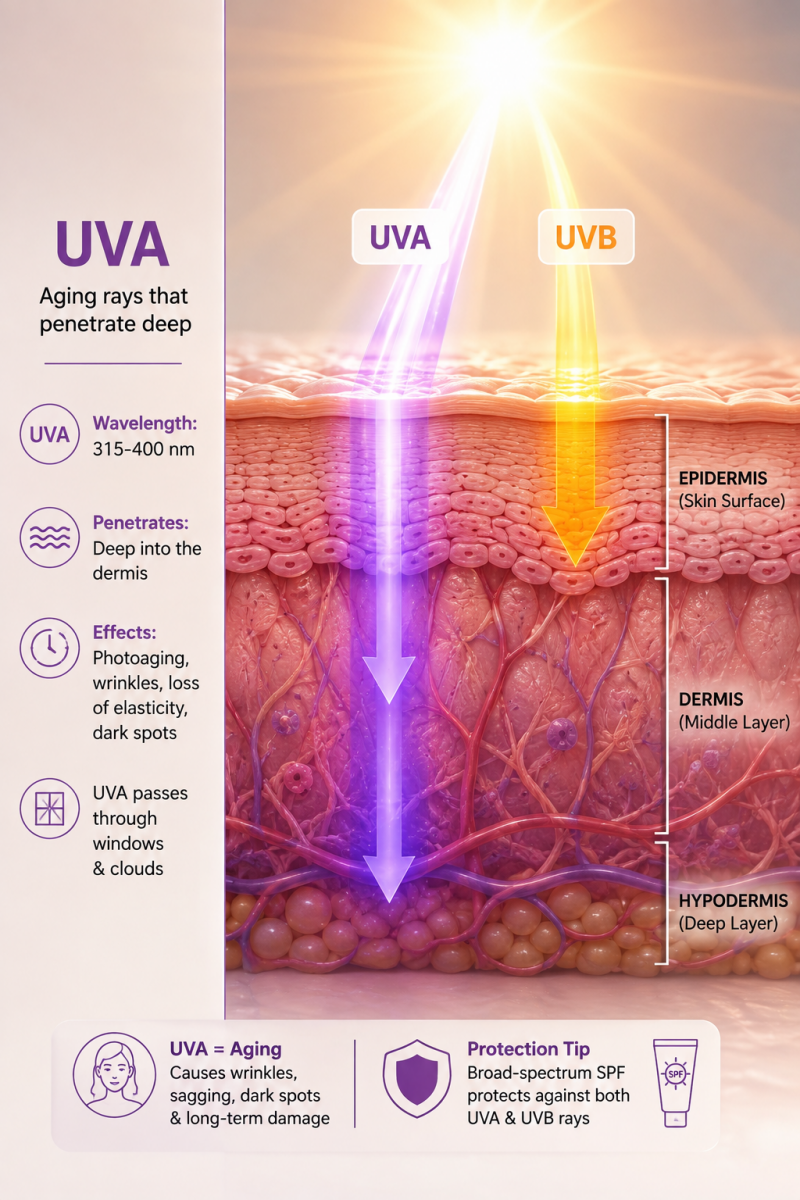
UVA: The Deeper-Aging Ray
UVA rays have a longer wavelength than UVB rays, allowing them to penetrate more deeply into the skin.
While UVB is absorbed mainly within the epidermis, UVA can travel farther into the dermis, where much of your skin's structural support system lives.
The dermis contains important structures including:
Collagen
Elastin
Fibroblasts
Blood vessels
Other components of the extracellular matrix
These structures help give skin its firmness, strength, flexibility, and resilience.
And this is one reason UVA plays such an important role in photoaging.
What Does UVA Do Once It Reaches the Dermis?
One of the major ways UVA damages skin is by increasing the formation of reactive oxygen species, commonly called free radicals.
Think of free radicals as unstable molecules that create oxidative stress inside the skin.
That oxidative stress can trigger processes that damage collagen and other components of the skin's supportive matrix.
UVA exposure can also increase enzymes known as matrix metalloproteinases, or MMPs.
These enzymes break down components of the extracellular matrix—including collagen. With repeated UV exposure over many years, this breakdown contributes to the changes we associate with sun-aged skin.
Over time, chronic UVA exposure can contribute to:
Fine lines
Wrinkles
Loss of firmness
Changes in elasticity
Uneven pigmentation
Rougher skin texture
Visible signs of premature aging
The important part?
You don't necessarily feel UVA damage happening.
There may be no burning sensation and no immediate warning sign.
Did You Know?
Approximately 95% of the ultraviolet radiation reaching Earth's surface is UVA, while UVB represents a much smaller percentage.
This does not mean UVB isn't dangerous—it absolutely is.
But it helps explain why UVA exposure is so important when we talk about the gradual, cumulative changes associated with photoaging.
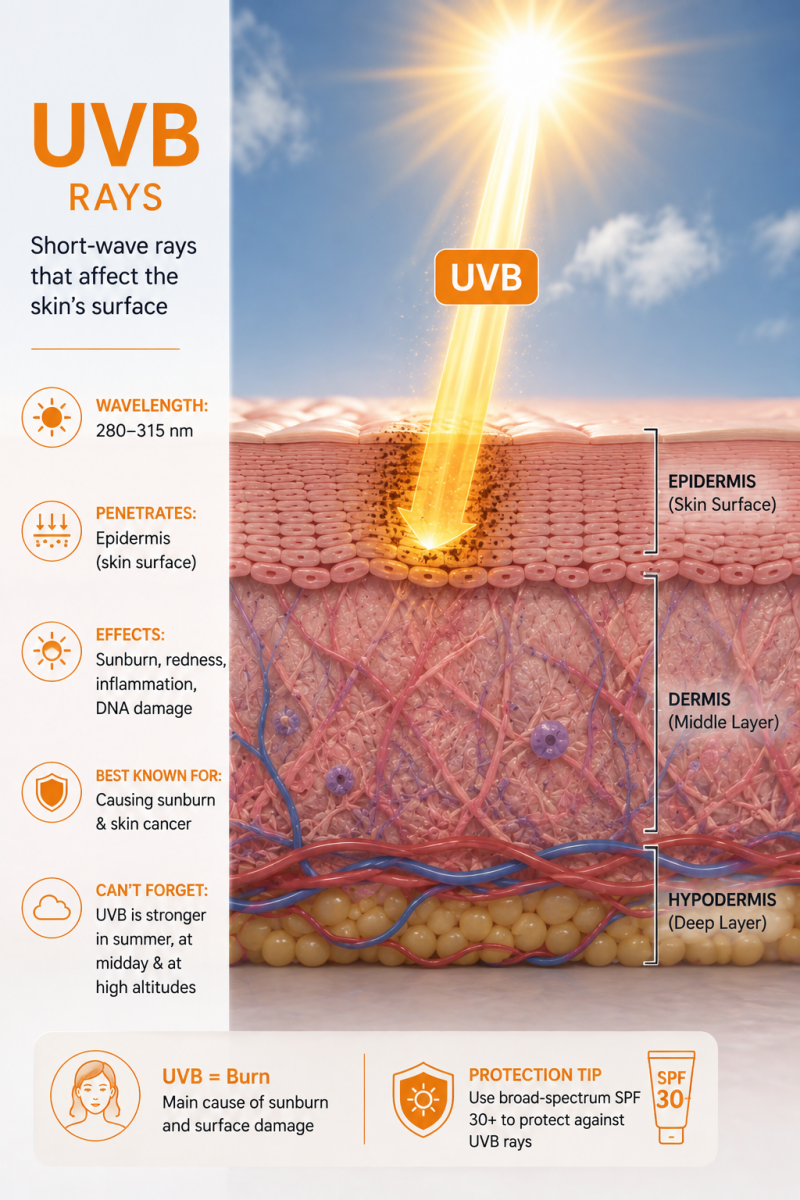
UVB: The Ray You Usually Notice
UVB has a shorter wavelength and contains more energy than UVA.
Unlike UVA, which reaches deeper into the skin, UVB radiation is absorbed predominantly within the epidermis—the outer portion of your skin.
UVB is the type of ultraviolet radiation most strongly associated with the classic sunburn.
So when you've spent too much time outside and your skin becomes:
red,
hot,
tender,
or painful,
UVB has played a major role in producing that inflammatory response.
But UVB Does More Than Cause Sunburn
A sunburn isn't simply temporary redness.
UVB photons can interact directly with DNA inside skin cells and create characteristic forms of DNA damage.
Your body has sophisticated repair mechanisms that attempt to correct this damage. But repeated exposure increases the burden placed on those repair systems.
When DNA damage accumulates or is repaired incorrectly, mutations can develop.
This is one reason repeated UV exposure is associated with an increased risk of skin cancers.
So while we often remember UVB as the "burning ray," it should never be thought of as only causing burns.
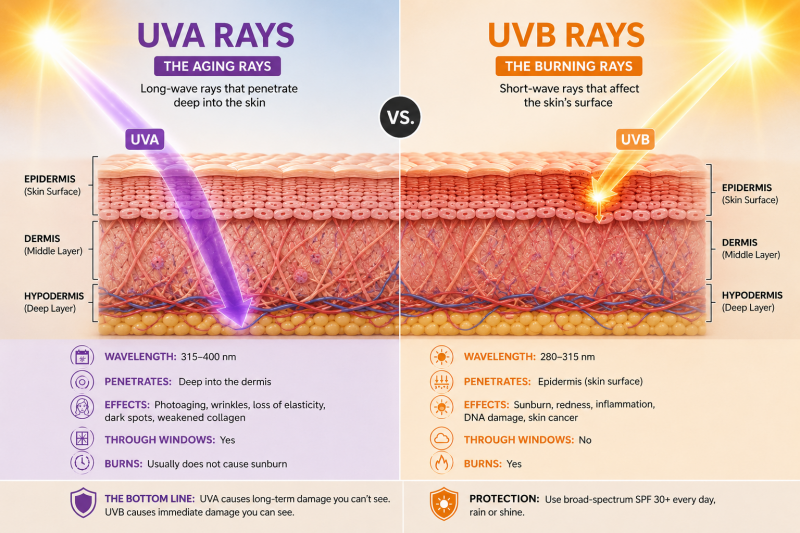
UVA vs. UVB: What's the Difference?
Here is the simplest way to picture it.
UVA
Travels deeper into the skin
Reaches into the dermis
Strongly associated with photoaging
Creates significant oxidative stress
Contributes to collagen and elastin damage
Contributes to pigmentation changes
Can pass through ordinary window glass
May cause damage without causing an obvious sunburn
UVB
Acts mainly closer to the surface
Is absorbed primarily in the epidermis
Is the major cause of sunburn
Causes direct DNA damage
Contributes to pigmentation and photoaging
Plays an important role in the development of skin cancer
Is largely blocked by ordinary window glass
Both matter.
And protecting yourself from only one is not enough.
Which One Causes More Skin Aging?
When we're specifically talking about photoaging, UVA deserves particular attention.
Because UVA penetrates into the dermis, it can affect the fibroblasts and structural proteins responsible for maintaining the skin's support system.
Repeated UVA exposure promotes oxidative stress and enzymes involved in collagen degradation.
Over years, those tiny exposures can gradually contribute to:
less organized collagen
damaged elastic fibers
wrinkles
loss of firmness
uneven pigmentation
and
rougher skin texture.
UVB also contributes to photoaging, however, so the goal isn't to choose between UVA and UVB.
Healthy sun protection needs to address both.

Here's Where It Gets Interesting: UVA Can Travel Through Windows
Have you ever thought:
"I'm inside the car, so I'm not really getting sun exposure"?
Not necessarily.
Ordinary glass blocks most UVB radiation very effectively.
But a significant amount of UVA can pass through window glass. The American Academy of Dermatology specifically notes that UVA rays can pass through windows while UVB is blocked by glass.
That means UVA exposure can still occur while you're:
🚗 Driving
🪟 Sitting beside a sunny window
💻 Working next to a large office window
☕ Sitting beside the window at a café
🏠 Spending hours beside bright windows at home
You may not feel hot.
You may not turn red.
You may not burn.
But exposure can still be occurring.
Think About Your Daily Commute
Imagine someone drives 30 minutes to work and 30 minutes home every weekday.
That's approximately:
1 hour per day
5 hours per week
260 hours per year
And that's before vacations, errands, patios, dog walks, outdoor activities or simply sitting beside sunny windows are considered.
One short drive doesn't suddenly age your skin.
The issue is cumulative exposure.
Five minutes here.
Twenty minutes there.
Driving to work.
Walking through a parking lot.
Sitting beside a window.
Walking the dog.
Gardening.
Eating lunch outside.
Over months, years, and decades, those exposures add up.
"But I Never Burn."
This is one of the biggest misconceptions surrounding sun damage.
A sunburn is NOT the only measurement of UV damage.
Remember:
UVB is very effective at producing the inflammatory reaction we recognize as sunburn.
UVA usually produces far less obvious immediate redness.
So you can experience significant UVA exposure without ever thinking:
"I got too much sun today."
The absence of a burn does not mean the absence of cellular damage.
Research has even demonstrated DNA changes following UV exposure at doses below those required to produce visible redness.
That's an important distinction.
What About Tanning Without Burning?
A tan is often misunderstood as a sign that someone's skin "handles the sun well."
Biologically, tanning is actually part of the skin's response to UV exposure.
UV radiation stimulates changes in melanin—the pigment that helps absorb and disperse some UV energy.
So although a tan may be considered attractive cosmetically, it is not evidence that the skin escaped UV exposure.
The American Academy of Dermatology puts it very simply: there is no safe way to tan from UV exposure; tanning itself indicates that the skin has been affected by ultraviolet radiation.
Why Doesn't Sun Damage Show Immediately?
This is where skin aging can be deceptive.
Most photoaging is cumulative.
Imagine putting one tiny scratch on a surface every day.
One scratch doesn't seem significant.
But repeat that process for 10, 20, 30 or 40 years and eventually the surface looks very different.
Your skin is far more sophisticated than that - it continuously repairs itself - but the basic idea helps explain cumulative photodamage.
Your skin is constantly attempting to:
repair DNA
replace damaged cells
manage oxidative stress
produce collagen
maintain its barrier
and repair its extracellular matrix.
But repeated environmental exposure can gradually overwhelm those repair processes.
And eventually, damage that accumulated invisibly begins appearing visibly.
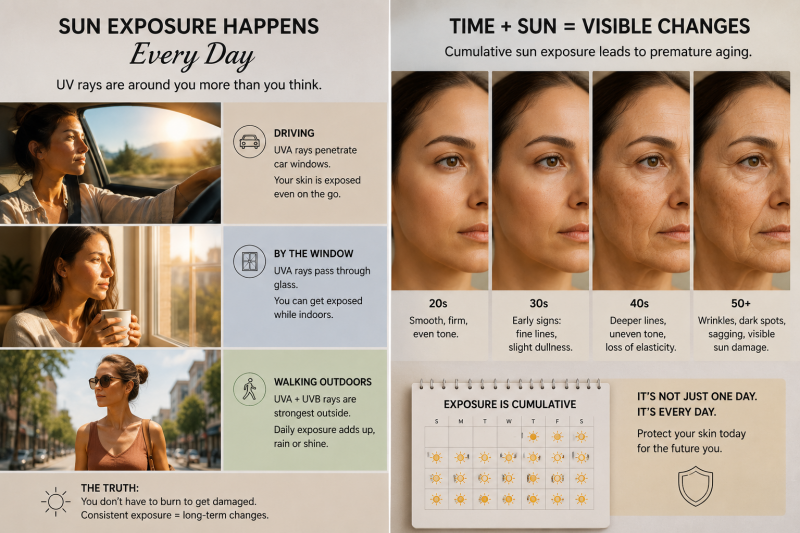
That's When We Start Seeing Photoaging
Photoaging can eventually appear as:
Fine lines and wrinkles
Repeated UV exposure affects collagen structure and promotes collagen-degrading enzymes.
Loss of firmness
Damage to collagen and elastic fibers reduces the supportive structure that helps skin remain firm and resilient.
Uneven pigmentation
UV exposure stimulates complex changes in melanocytes and melanin production, contributing to freckles, sun spots, and uneven pigmentation.
Rough texture
Long-term UV exposure can alter normal skin structure and renewal.
Visible blood vessels and redness
Chronic photodamage can also contribute to vascular changes within the skin.
Some of these changes may not become obvious until years after the exposure responsible for creating them occurred.
The Windshield Question: "Do I Need Sunscreen in the Car?"
For regular daily life, this is exactly why broad-spectrum sun protection matters.
"Broad spectrum" means the sunscreen is designed to protect against both UVA and UVB radiation.
SPF primarily tells us about protection against UVB-induced sunburn.
So don't simply look for a large SPF number.
Look for:
BROAD SPECTRUM
and ideally:
SPF 30 or higher
You can choose mineral sunscreen without added chemicals and look for zinc oxide as main and only ingredient.
And sunscreen should be only one part of your strategy.
Shade, hats, clothing, sunglasses, and limiting excessive exposure all matter too.
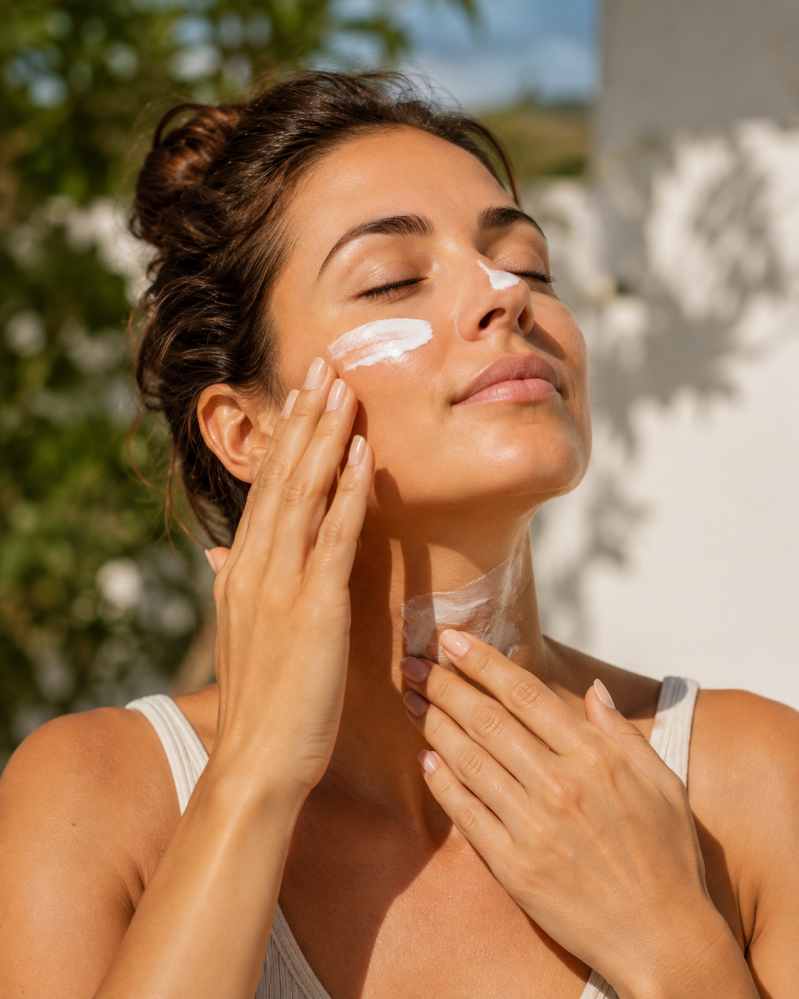
One of the Best Anti-Aging Products Isn't a Serum
People often ask which serum, facial, peel, microneedling treatment or anti-aging ingredient will make the biggest difference to their skin.
Professional treatments and well-formulated skincare can absolutely help support healthier-looking skin.
But there's an important reality:
We cannot talk seriously about preventing premature skin aging without talking about sun protection.
You can invest in beautiful skincare.
You can stimulate collagen.
You can exfoliate.
You can treat pigmentation.
You can improve hydration.
But if your skin continues receiving significant unprotected UV exposure, you're continuing to expose it to one of the major environmental forces responsible for the changes you're trying to improve.
Sun protection isn't the glamorous part of skincare.
It's the foundation.
Prevention Doesn't Mean Avoiding the Outdoors
Healthy sun habits aren't about being afraid of sunlight or never enjoying the outdoors.
They're about understanding what is happening to your skin and making informed choices.
That might mean:
Using broad-spectrum sunscreen
Reapplying when appropriate
Wearing a hat during prolonged exposure
Choosing shade when possible
Protecting your skin during long drives
Being mindful of sunny windows
and simply remembering that sun protection isn't reserved for beach days.
A.T Alternative Wellness Perspective
If there's one thing I want you to remember from this article, it's this:
Sun damage does not begin when your skin burns.
UVA can quietly penetrate deeper into your skin and contribute to oxidative stress, collagen breakdown, pigmentation changes and premature aging without creating an obvious sunburn.
UVB is more likely to give you the immediate warning sign of redness and burning, but it can also cause significant DNA damage and contribute to photoaging.
Your skin remembers cumulative exposure, not simply the days you got burned.
So instead of thinking:
"Am I going to burn today?"
a better skincare question is:
"How am I protecting my skin from cumulative UV exposure?"
Because some of the most effective anti-aging skincare decisions aren't about reversing damage later.
They're about reducing unnecessary damage today.
Healthy skin is a long-term relationship—and protecting it is part of caring for it.
Want to know what does SPF 30, 50 or 100 Actually Mean? Coming soon