

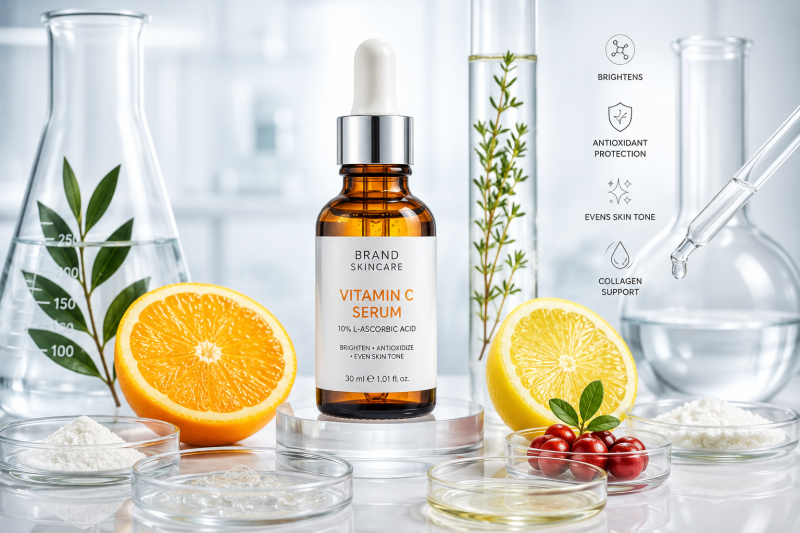
What Should You Avoid Using With L-Ascorbic Acid?
Vitamin C Is Powerful—but What You Use With It Matters
You’ve found a Vitamin C serum containing L-ascorbic acid, perhaps at 10%, 15% or even 20%.
Now comes another important question:
What can you use with it—and what should you avoid?
L-ascorbic acid is the active and most extensively studied form of Vitamin C used in skincare. It acts as an antioxidant and can help support collagen production, brighten the appearance of uneven skin tone and protect the skin against oxidative stress.
But L-ascorbic acid can also be irritating for some skin types, particularly at higher concentrations.
This is where your entire skincare routine becomes important.
The issue isn't always that two ingredients cannot be used together.
Sometimes the problem is simply:
Too many powerful ingredients + one skin barrier = irritation.
Let's break it down.
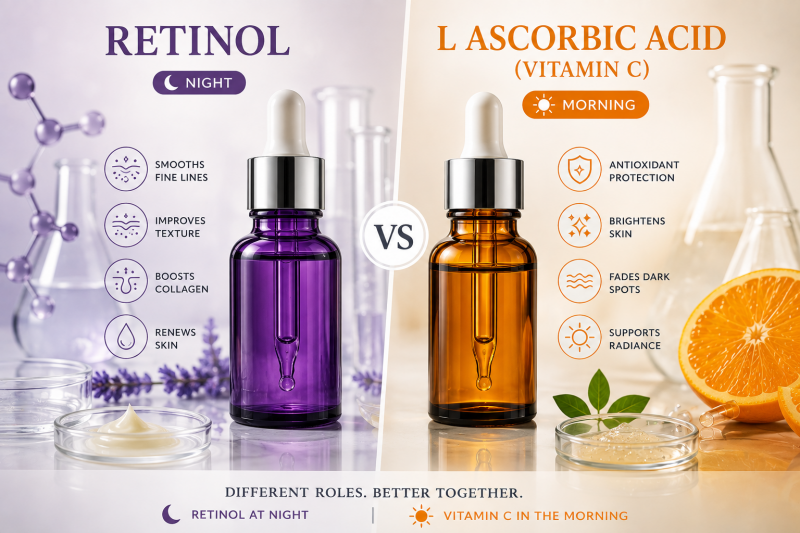
Retinol + L-Ascorbic Acid
Can you use them together?
Potentially, yes.
But that doesn't mean everyone should start by applying them in the same routine.
Both L-ascorbic acid and retinoids are powerful skincare ingredients. For someone who is new to active skincare, sensitive, dry or already experiencing barrier irritation, layering them can potentially increase:
• Dryness
• Redness
• Stinging
• Flaking
• Sensitivity
A simple approach
☀️ Morning: Vitamin C
🌙 Evening: Retinol
This allows you to benefit from both ingredients while keeping the routine simple.
Once we know how your skin responds, the routine can be adjusted accordingly.
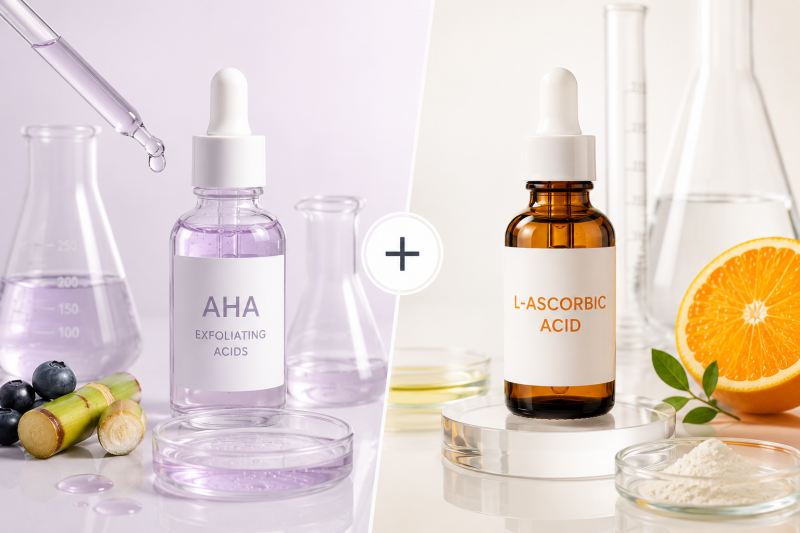
AHA Exfoliating Acids + L-Ascorbic Acid
AHAs include ingredients such as:
Glycolic acid
Lactic acid
Mandelic acid
Can they technically exist in the same skincare routine as Vitamin C?
Yes.
But combining an acidic L-ascorbic acid serum with exfoliating acids may be unnecessarily irritating for some people.
If your skin starts feeling tight, burning, unusually sensitive or increasingly red, that's not something you should simply push through because the ingredients are considered “good for your skin.”
More actives don't automatically mean better skin.
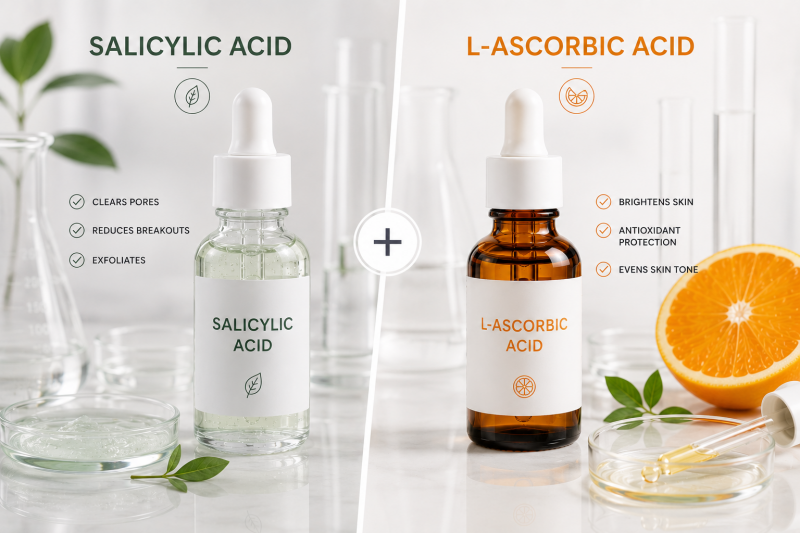
Salicylic Acid + L-Ascorbic Acid
Salicylic acid is a BHA commonly found in products designed for oily, congested and acne-prone skin.
Again, these ingredients aren't universally incompatible.
The concern is tolerance.
If you're using a strong salicylic acid treatment and then adding a strong acidic Vitamin C serum, your skin may become irritated—particularly if you're also using retinol, exfoliating toners or other active treatments.
This is one reason I look at a client's entire routine, rather than evaluating one product at a time.
Strong At-Home Peels + L-Ascorbic Acid
This is where I would be much more cautious.
If you're performing a strong exfoliating peel at home, immediately adding a high-strength L-ascorbic acid serum may cause considerable stinging and irritation.
After significant exfoliation, the priority should be supporting the skin barrier—not seeing how many active ingredients we can apply.
Your skin doesn't need to feel like it's burning for a product to be working.
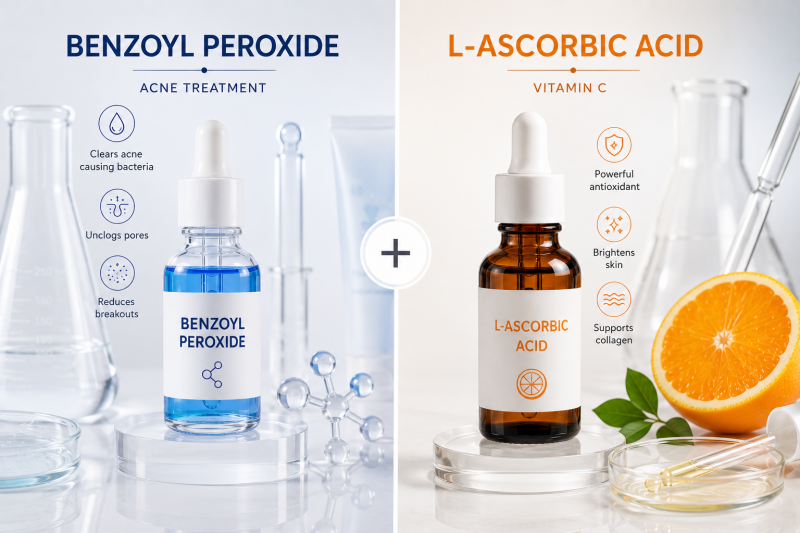
Benzoyl Peroxide + L-Ascorbic Acid
Benzoyl peroxide is an oxidizing ingredient commonly used in acne treatment.
Because L-ascorbic acid is an antioxidant and benzoyl peroxide is an oxidizing agent, I generally prefer separating them rather than layering them directly together.
For example:
☀️ Vitamin C in one routine
🌙 Benzoyl peroxide in another
The exact routine should still depend on the person's skin and acne treatment plan.
Physical Scrubs + L-Ascorbic Acid
The issue here isn't a chemical incompatibility.
It's irritation.
Aggressive scrubbing can compromise the skin barrier. Following that immediately with an acidic L-ascorbic acid serum may result in significant stinging and redness.
If Vitamin C suddenly burns when it normally doesn't, don't automatically blame the Vitamin C.
Ask:
What happened to the skin before I applied it?
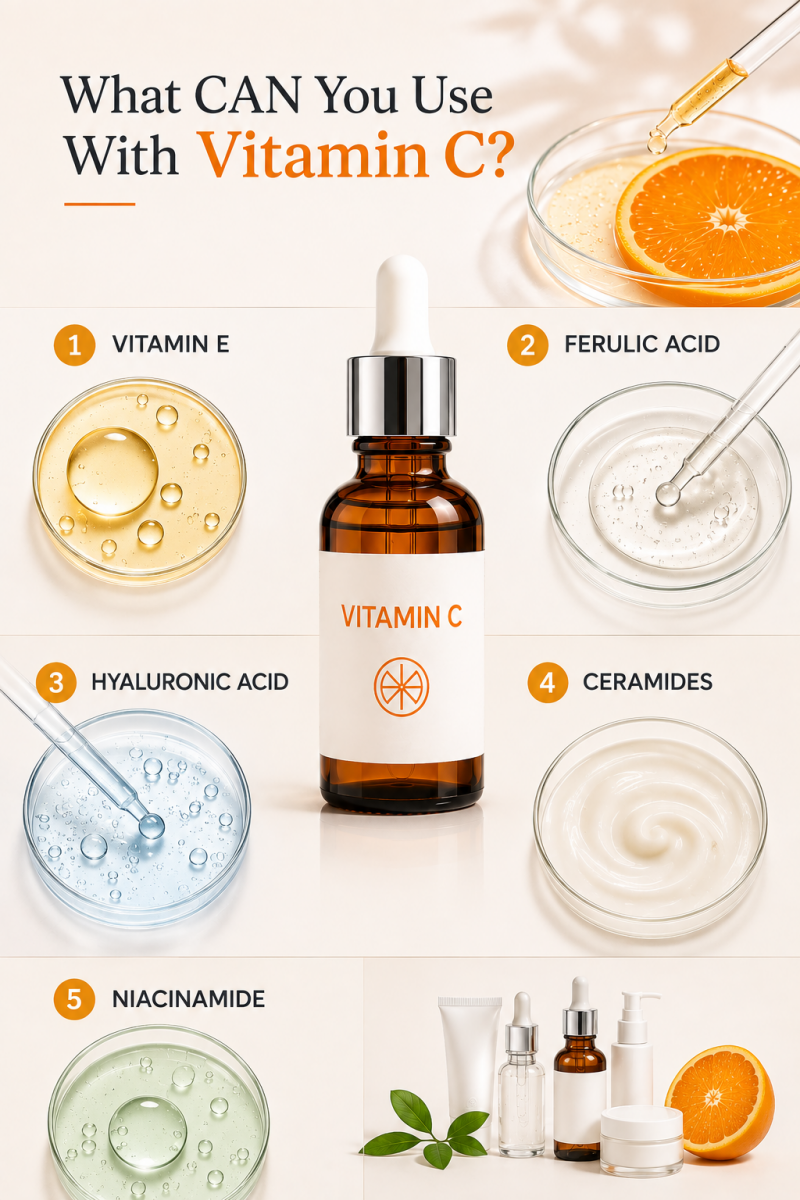
What CAN You Use With Vitamin C?
Now for the good news.
There are many ingredients that can work beautifully alongside Vitamin C.
Vitamin E
Vitamin E is another antioxidant and is commonly combined with L-ascorbic acid in sophisticated antioxidant formulations.
Ferulic Acid
Ferulic acid is another antioxidant frequently paired with Vitamins C and E.
This is why you may see professional antioxidant formulas containing:
Vitamin C + Vitamin E + Ferulic Acid
It's not a random combination.
The complete formulation matters.
Hyaluronic Acid
Hyaluronic acid can be an excellent addition to a Vitamin C routine because it helps support hydration without adding another strong exfoliating active.
Ceramides
Ceramides help support the skin barrier and can be particularly useful if you're incorporating stronger active ingredients into your routine.
Niacinamide
Here's an old skincare myth that still circulates:
“Never use Niacinamide with Vitamin C.”
For most modern skincare routines, this isn't a rule you need to follow.
Niacinamide and Vitamin C can generally be incorporated into the same routine when the formulations and the individual's skin tolerate them.
A Simple Vitamin C Routine
If you're confused by all the skincare advice online, start simple.
MORNING ☀️
1. Gentle cleanser
↓
2. L-Ascorbic Acid Vitamin C serum
↓
3. Hydrating serum if needed
↓
4. Moisturizer
↓
5. Broad-spectrum sunscreen
SPF is particularly important because Vitamin C should complement—not replace—your daily sun protection.
EVENING 🌙
1. Cleanser
↓
2. Your selected treatment
This might be retinol, an exfoliating acid or another treatment appropriate for your skin.
↓
3. Moisturizer / barrier-supporting skincare
You don't need every active ingredient every night.
The Biggest Mistake I See?
Using too many actives because every ingredient sounds beneficial.
Vitamin C.
Retinol.
Glycolic acid.
Salicylic acid.
Azelaic acid.
Peptides.
Niacinamide.
Hyaluronic acid.
All of these ingredients may have a place in skincare.
But that doesn't mean your skin needs all of them at once.
Sometimes simplifying a routine produces better results than continuously adding another serum.

This Is Where Professional Consultation Matters
Two people can purchase exactly the same 15% L-ascorbic acid serum and have completely different experiences.
Why?
Because we're not treating a bottle.
We're treating the skin using the product.
Before recommending a routine, I consider factors such as:
• Skin type and current condition
• Sensitivity and barrier health
• Pigmentation concerns
• Acne and congestion
• Current skincare products
• Professional treatments being performed
• How frequently active ingredients are being used
• How the skin is actually responding
At A.T. Alternative Wellness, my approach is not about giving every woman the strongest product available.
It's about finding the right ingredients, formulations and routine for her individual skin.
Because good skincare isn't:
“What is the strongest product I can buy?”
It's:
“What does my skin actually need?”
Ingredient Lab Takeaway 🧪
When using L-ascorbic acid:
USE WITH:
✓ Vitamin E
✓ Ferulic acid
✓ Hyaluronic acid
✓ Ceramides
✓ Niacinamide, when tolerated
USE WITH CAUTION:
⚠ Retinol/retinoids
⚠ Glycolic and other AHAs
⚠ Salicylic acid
⚠ Benzoyl peroxide
⚠ Strong exfoliating treatments
⚠ Aggressive physical scrubs
These ingredients aren't necessarily “forbidden” combinations.
The real question is:
Can YOUR skin tolerate them together?
A.T. Alternative Wellness
Ingredient Lab — Skincare education beyond the label.
Need help making sense of your skincare routine?
Let’s take a closer look at your skin, the products you’re using and what your skin actually needs.